Standards We Measure Against

Standards We Measure Against

Where possible, CRAG compares physical and chemical test results against national standards. There are four sets of standards that must be considered:

  1. The Water Framework Directive (WFD) (https://www.legislation.gov.uk/uksi/2017/407/contents) – the main set of standards that describes the chemical and biological tests that should be used to assess the quality of water. The organisation tasked with updating this guidance document and adjusting standards to UK condition as scientists learn more is UKTAG. Their website has updated guidance for some WFD standards (https://www.wfduk.org/resources/category/environmental-standards-202/publication-status/3).
  2. The Common Standards Monitoring Guidance for Rivers (CSMG) (https://jncc.gov.uk/our-work/common-standards-monitoring-guidance/) – standards for a smaller set of chemical tests specific to SSSI (Site of Special Scientific Interest). The Coquet from source to the tidal limit and two major burns (Alwin catchment and Wreigh burn from the Netherton burn to the Coquet) are part of the River Coquet and Coquet woodlands SSSI. In addition to this main river SSSI, there are many woodland SSSIs in the Coquet catchment and SSSIs along the coast.
  1. The WFD does not have standards for nitrate, yet nitrate levels are likely to be of concern in some of the lowland arable areas of the Coquet catchment. CRAG have attempted to assimilate information on nitrate and nitrogen in a paper published on this website (Nitrogen in Water).
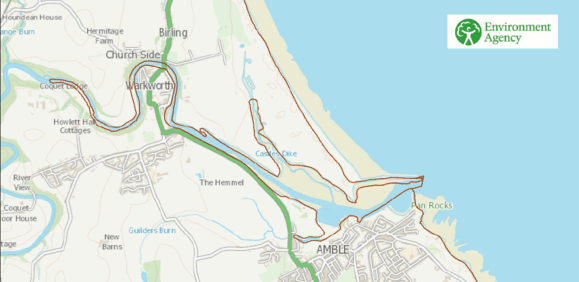
  2. UK Bathing Water Regulations (BWR) (https://www.legislation.gov.uk/uksi/2013/1675/contents/made) set standards for bathing waters, specifically E. coli and Intestinal Enterococci. Amble links and Warkworth beach are specifically named in this legislation and therefore must be monitored by the Environment Agency. CRAG is aiming to apply for bathing water status for the estuarine harbour near Little Shore in Amble. The Environment Agency map below indicates the extent of the estuarine waters near the Coquet mouth. The salinity of sea water is 35ppt (parts per thousand). The salinity of estuarine water is between 0.5ppt and 35ppt. The salinity at the Amble Pier, while hugely variable, averages at about 22ppt.

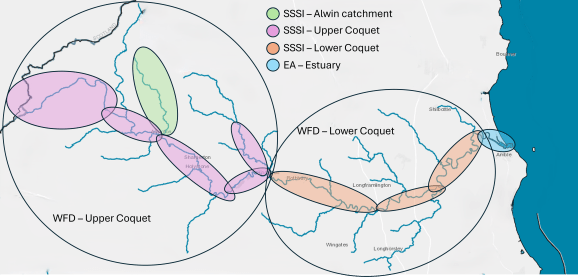
To assign the correct standards to the River Coquet, we need to place each water body into a category. We can identify 7 categories:

  • SSSI Alwin catchment – the Alwin burn
  • SSSI Upper Coquet – the main Coquet River from the source to the junction with the Wreigh burn and the Wreigh burn from the Netherton burn to the Coquet
  • SSSI Lower Coquet – the main Coquet River from the Wreigh burn to the tidal limit
  • EA Estuary – Amble and Warkworth from the tidal limit (Warkworth dam) to the sea
  • WFD Upper Coquet – all burns upstream of the Wreigh burn, including the Usway burn, Ridless burn, Barrow burn, Holystone burn, Grasslees burn, Wreigh burn above the Netherton burn, and tributaries of the Wreigh burn (Back burn, Foxton and Netherton burns)
  • WFD Lower Coquet – all burns between Wreigh burn and the tidal limit, including the Black burn, Forest burn, Todd burn, Swarland burn, Thirston and Longdike burns, Hazon burn and Tyelaw burn

Using the standards and categorisation of River Coquet water bodies described above, the standards against we will measure our chemical and biological tests are in the tables below.

Please note the following:

  • Abbreviations for the ‘Source for Standards’ are as follows: CSMG – Common Standards Monitoring Guidance; WFD – Water Framework Directive; NIW – CRAG Nitrogen in Water paper; BWR – UK Bathing Water Regulations.
  • cfu = colony forming units (i.e. the number of bacteria colonies formed on an agar plate at 36C in 24 hours from a 100mL sample).
  • Our Hanna phosphate checker measures orthophosphate. We must divide our reading by 3.066 to convert this reading to orthophosphate as P for comparison with the standard here.
  • Our Nitrate meters and nitrate test strips measure Nitrate. To convert values to Nitrate as N, we need to multiply the reading by 0.266.
  • Dissolved inorganic nitrogen = Ammonia as N + Nitrate as N + Nitrite as N. For Ammonia to Ammonia as N conversion, multiply reading by 0.78. For Nitrite to Nitrite as N conversion, multiply reading by 0.304.

SSSI Alwin catchment

TestSource for standardHigh qualityGood qualityModerate qualityPoor quality
Dissolved oxygenCSMG> 85% saturation< 85% saturation
Biological oxygen demand (BOD)CSMG< 2.5 mg/L> 2.5 mg/L
pHWFD6.0 – 9.04.7 – 6.0< 4.7
TemperatureWFD< 20 C20-23 C23-28 C> 28 C
Orthophosphate as PCSMG< 0.010 mg/L>0.010 mg/L
Total AmmoniaCSMG< 0.25 mg/L> 0.25 mg/L
Nitrate as NNIW< 0.7 mg/L0.7-1.2 mg/L1.2-1.9 mg/L> 1.9 mg/L
E. coliBWR< 500 cfu500-900 cfu> 900 cfu
Intestinal enterococciBWR< 200 cfu200-330 cfu> 330 cfu

SSSI Upper Coquet

TestSource for standardHigh qualityGood qualityModerate qualityPoor quality
Dissolved oxygenCSMG> 85% saturation< 85% saturation
Biological oxygen demand (BOD)CSMG< 2.5 mg/L> 2.5 mg/L
pHWFD6.0 – 9.04.7 – 6.0< 4.7
TemperatureWFD< 20 C20-23 C23-28 C> 28 C
Orthophosphate as PCSMG< 0.015 mg/L>0.015 mg/L
Total AmmoniaCSMG< 0.25 mg/L> 0.25 mg/L
Nitrate as NNIW< 0.7 mg/L0.7-1.2 mg/L1.2-1.9 mg/L> 1.9 mg/L
E. coliBWR< 500 cfu500-900 cfu> 900 cfu
Intestinal enterococciBWR< 200 cfu200-330 cfu> 330 cfu

SSSI Lower Coquet

TestSource for standardHigh qualityGood qualityModerate qualityPoor quality
Dissolved oxygenCSMG> 85% saturation< 85% saturation
Biological oxygen demand (BOD)CSMG< 2.5 mg/L> 2.5 mg/L
pHWFD6.0 – 9.04.7 – 6.0< 4.7
TemperatureWFD< 20 C20-23 C23-28 C> 28 C
Orthophosphate as PCSMG< 0.030 mg/L>0.030 mg/L
Total AmmoniaCSMG< 0.25 mg/L> 0.25 mg/L
Nitrate as NNIW< 1.5 mg/L1.5-2.4 mg/L2.4-3.7 mg/L> 3.7 mg/L
E. coliBWR< 500 cfu500-900 cfu> 900 cfu
Intestinal enterococciBWR< 200 cfu200-330 cfu> 330 cfu

EA Estuary

TestSource for standardHigh qualityGood qualityModerate qualityPoor quality
Dissolved oxygenWFD> 6.2 mg/L4.4-6.2 mg/L2.6-4.4 mg/L< 2.6 mg/L
pHWFD6.0 – 9.04.7 – 6.0< 4.7
TemperatureWFD< 20 C20-23 C23-28 C> 28 C
Orthophosphate as PEA (calculated using WFD)< 0.031 mg/L0.031-0.051 mg/L0.051-0.155 mg/L>0.155 mg/L
Total AmmoniaWFD< 0.3 mg/L0.3-0.6 mg/L0.6-1.1 mg/L> 1.1 mg/L
Dissolved inorganic nitrogenNIW< 1.4 mg/L> 1.4 mg/L
E. coliBWR< 250 cfu**250 -500 cfu**> 500 cfu**
Intestinal enterococciBWR< 100 cfu**100 -185 cfu**> 185 cfu**

WFD Upper Coquet catchment

TestSource for standardHigh qualityGood qualityModerate qualityPoor quality
Dissolved oxygenWFD> 80% saturation75%-80% saturation64%-75% saturation< 64% saturation
Biological oxygen demand (BOD)WFD< 3.0 mg/L3.0-4.0 mg/L4.0-6.0 mg/L 
pHWFD6.0 – 9.04.7 – 6.0< 4.7
TemperatureWFD< 20 C20-23 C23-28 C> 28 C
Orthophosphate as PEA (calculated using WFD)< 0.031 mg/L0.031-0.051 mg/L0.051-0.155 mg/L>0.155 mg/L
Total AmmoniaWFD (Type 4)< 0.20 mg/L0.20-0.30 mg/L0.30-0.75 mg/L> 0.75 mg/L
Nitrate as NNIW< 0.7 mg/L0.7-1.2 mg/L1.2-1.9 mg/L> 1.9 mg/L
E. coliBWR< 500 cfu500-900 cfu> 900 cfu
Intestinal enterococciBWR< 200 cfu200-330 cfu> 330 cfu

WFD Lower Coquet catchment

TestSource for standardHigh qualityGood qualityModerate qualityPoor quality
Dissolved oxygenWFD> 80% saturation75%-80% saturation64%-75% saturation< 64% saturation
Biological oxygen demand (BOD)WFD< 3.0 mg/L3.0-4.0 mg/L4.0-6.0 mg/L 
pHWFD6.0 – 9.04.7 – 6.0< 4.7
TemperatureWFD< 20 C20-23 C23-28 C> 28 C
Orthophosphate as PEA (calculated using WFD)< 0.031 mg/L0.031-0.051 mg/L0.051-0.155 mg/L>0.155 mg/L
Total AmmoniaWFD (Type 5)< 0.30 mg/L0.30-0.60 mg/L0.60-1.10 mg/L> 1.10 mg/L
Nitrate as NNIW< 1.5 mg/L1.5-2.4 mg/L2.4-3.7 mg/L> 3.7 mg/L
E. coliBWR< 500 cfu500-900 cfu> 900 cfu
Intestinal enterococciBWR< 200 cfu200-330 cfu> 330 cfu