
“The Coquet, from its mouth to its source, is one of the most lovely streams in the north of England”
said William Andrew Chatto in his book ‘Rambles in Northumberland and on the Scottish Borders’ published in 1835. And we want to keep it that way.
We’re a collaboration of community groups along the Coquet River who have joined together to help maintain and improve the Coquet River catchment. Along with the Northumberland River’s Trust, we are Women’s Institutes, Parish Councils and environmental groups, aiming to work with our communities, landowners and businesses to look after our unique environment.
The celebrations continue for Little Shore. The CRAG Little Shore volunteers have been shortlisted for the LOVE Northumberland Awards for their successful bathing water designation application. See the blog here.
—
Come and join us at any of our Events.
Upcoming Events
Now we have celebrated Amble’s Little Shore achieving bathing water status, it’s back to work. This summer will be packed full of different sorts of activity.
Some of our volunteers have already been out to remove Himalayan balsam in Rothbury (see our Facebook page), and we have plans to attack patches in the Tod burn and along the River Coquet from Rothbury down to Weldon Bridge. Contact us on the email below if you would like to help.
Our volunteers will continue to measure nutrients in the river at least each month. We hope, at some of our sites, to also monitor riverfly (water invertebrate larvae). This monitoring is perhaps the best measure of the overall health of the river. We have had a few half-hearted attempts to get this going but this summer we hope to do more. Again, contact us if you are interested in helping.
Our experience last year has shown that measuring E. coli is a very good way of detecting sewage spills. We can use this information to inform our communities about the safety of the water for swimming. With bathing water designation for Little Shore, the Environment Agency will be monitoring E. coli and informing the public about the safety of this beach. We will continue to monitor further upstream to ensure that some of the swimming areas near our villages continue to be safe.
For more information about our past events, please go to our events page.
—
What have we learned about the River Coquet?
CRAG now has been measuring water quality for over two years. What have we found?
Well, in general terms, we have found the main river to be good quality – the nutrient levels are most often low. The reason for this is the high water flow rate, such that when there are nutrients from sewage or agriculture entering the river, there is enough water to dilute these nutrients to a safe level. Even in the summer of 2025 when we received very little rain, there was enough water flowing to continue this dilution effect.
Now that doesn’t mean that there were no problems. Several of the sewage treatment plants overflowed regularly – particularly the Felton sewage treatment plant in 2025. Our E. coli tests allowed us to follow the flow of sewage down the river – for the week after a sewage spill, we could follow the E. coli flowing down from the Felton sewage treatment plant down to Warkworth, and from the Thropton and Snitter sewage treatment plant down to Brinkburn.
Where we have greater problems is along some of our tributaries. The tributaries have much less water flow and so the nutrient levels do not become as dilute. The tributaries with most nutrients are the Longdyke and Thirston burns, the Hazon burn and the Tyelaw/Grange burn. These tributaries both drain agricultural land and have a sewage treatment plant. Several smaller tributaries that drain agricultural land near Warkworth and Amble, the Birling Beck and Guilders burn, also tend to have high nutrient levels.
Now, why are high nutrient levels a problem? Nutrient allow algae and bacteria to grow in the water. When algae levels are very high (algal bloom), they use all the oxygen in the water which kills fish and other animals (i.e. riverfly). When algae levels are moderately high, fish may not die but riverfly can still be smothered. In summer, some of our tributaries display stringy bright green algae, indicating moderate to high algae levels.
To see more of our data, please go to our knowledge hub.
—
CRAG isn’t all about science. We know that for many people the river is about activity, about community and belonging, and about livelihood.
There are many creative people along our river who gain inspiration from the River Coquet. We wish to celebrate some of this inventiveness. We have composers, writers and visual artists who like to let us know how the river affects them. Check out these artistic responses to the River Coquet (Creative responses to the River Coquet).
Have a look at this video. It was donated to us by Pockets Projects Ltd. It introduces the River Coquet and some of what CRAG is doing.
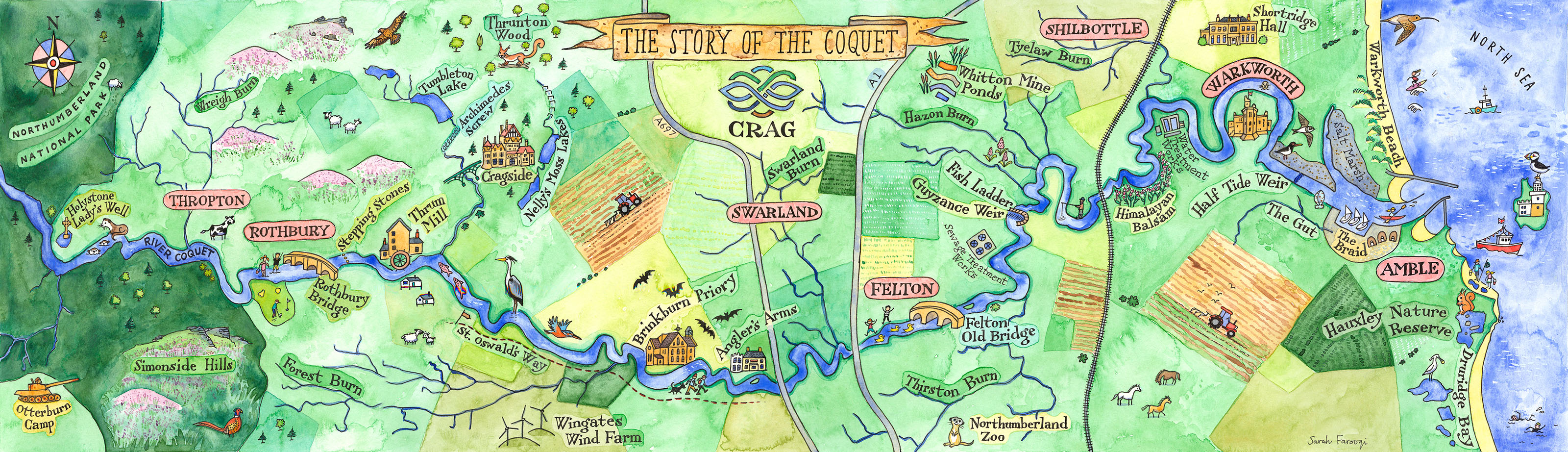
While we are at it, the header picture was also donated. You can buy a print from our friend Sarah Farooqi (https://www.sarahfarooqi.co.uk/prints/story-of-the-coquet), who will donate 10% of the payment to CRAG.
—
CRAG has been very lucky to receive some very generous donations and funding. Please look here at the full list of donors and funders.
Our latest and largest funders have been the National Lottery, and Garfield Weston / Northumberland Rivers Trust.

—
Contact us:
Email: coquetriveractiongroup@outlook.com