Water Quality Testing
Physical and Chemical Tests
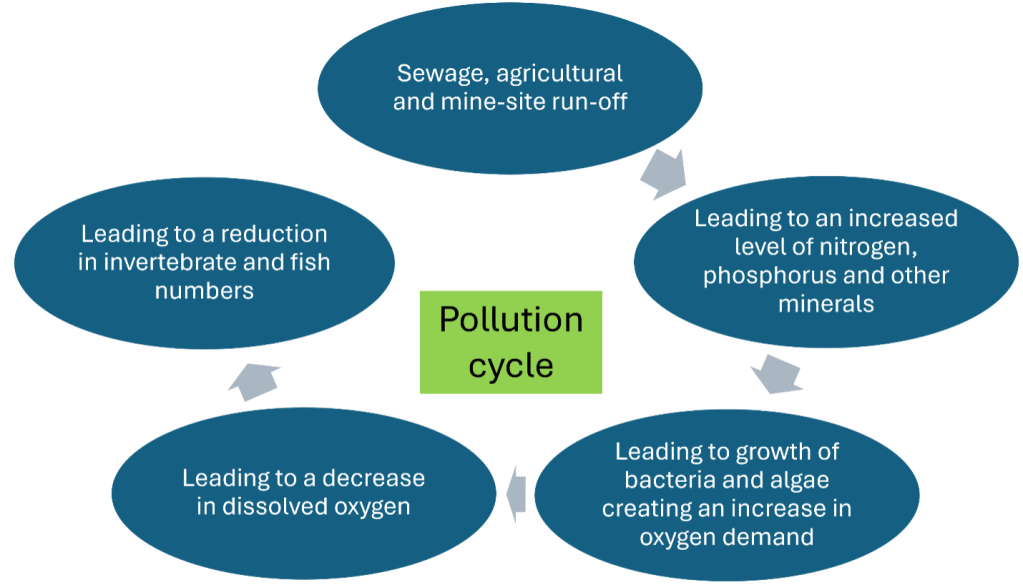
By understanding the pollution cycle and with reference to the Water Framework Directive, we have selected physical and chemical tests that help us monitor the health of the river. These are tests that have been recommended to us by the Environment Agency. They are also tests that are commonly used by other Citizen Science groups in the UK.
The most important tests are for those chemicals considered limiting for bacteria and algae growth. In freshwater (most of the river) the limiting chemical is generally phosphorus. In estuarine and seawater the limiting chemical is generally nitrogen.
Our long-term and regular monitoring of physical and chemical properties, alongside those of the Anglers Association, the Environment Agency and other government and non-government organisations, will provide evidence for improvement or deterioration of the water quality of the Coquet River.
The scientific relevance of our testing depends upon groups along the Coquet using the same tests, receiving the same training and testing water samples at the same time. In general, this is the case for groups that are part of CRAG; however, we have allowed for some local flexibility in:
- The tests used – to ensure the chosen tests are relevant to fresh water or estuarine water
- The timing – because some groups choose to test more regularly

The physical and chemical tests CRAG groups have chosen to perform are (see biological surveys and tests here):
| Fresh water | Estuarine | |
| All groups | – pH and temperature – Ammonia and phosphate – Dissolved solids (electroconductivity) | – pH and temperature – Ammonia and phosphate – Salinity |
| Some groups (depending on local preference, cost and suitability for local test sites) | – Nitrate – Suspended solids (turbidity) – Biological oxygen demand (BOD, permanganate) | – Nitrate – Turbidity |
We carry out physical and chemical tests at least once a month at each test site (hyperlink to ‘CRAG Background and rationale for water quality testing’ in Knowledge Hub). We capture results in the ‘Coquet River Action Group’ EpiCollect project. The Environment Agency monitors our results and uses them to trigger investigations of water quality.
We compare these test results against national standards, which depend on the location. To read about these standards in detail and where each site falls, follow the link below:
 CRAG
CRAG 