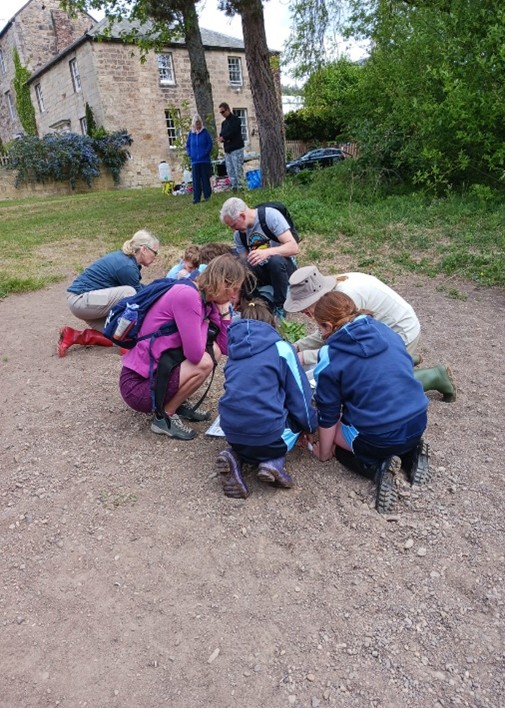
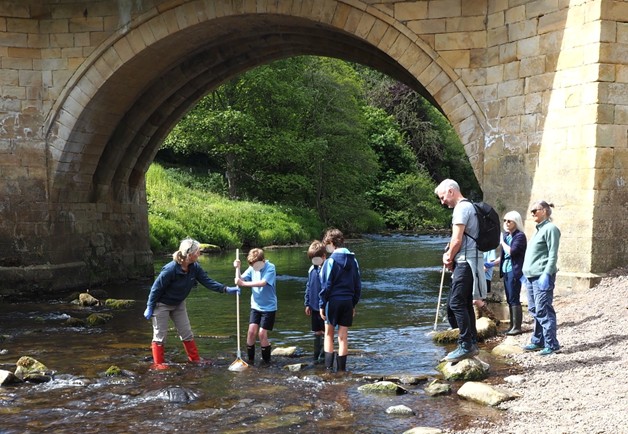
CRAGs Rothbury WI and Rothbury CAN water quality groups were out on a fine morning in May, riverfly sampling with the Dr Thomlinson C of E Middle School Biodiversity Group. The event marked the launch of CRAG’s riverfly kick sampling project, to collect data on riverfly numbers at different sites along the Coquet.
Riverfly kick sampling is a technique that provides a measure of the river’s health by recording numbers of riverfly over time to track any changes. Along with other freshwater invertebrates, riverfly are at the heart of the freshwater ecosystem and provide a vital link in the aquatic food chain. Their limited mobility, relatively long-life cycle, presence throughout the year, and specific tolerances to changes in environmental conditions make them good indicators of water quality.
We were delighted to be assisted by over 20 children from the local middle school biodiversity group, who walked down from the school in their wellies to learn about the importance of invertebrates to freshwater ecosystems, the kick testing method used to obtain a sample and the identification techniques required to tell your Caddisflies from your Mayflies. One of the conclusions of the morning was surely that it’s not as easy as it looks to identify different species, even with a useful ID chart to hand; especially as they don’t keep still! Luckily after all that activity there was some squash and homemade cake to fortify teachers and children for the walk back up the hill to school.
If anyone is interested in taking part in riverfly sampling or learning more about the projects CRAG is involved in on the Coquet please do contact us coquetriveractiongroup@outlook.com.
Photos: Left – Introduction to riverfly whilst disinfectant on boots dries; Right – Close examination needed!
Photo: Good kicking technique is essential to get a decent sample!
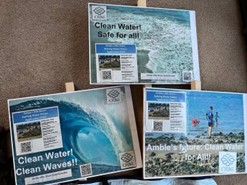
On 13th May 2025, CRAG launched a public consultation supporting a bid for bathing water status for Amble’s Little Shore Beach. You can read about that on our previous blog post, but here is what we’ve been up to since!
Amble Puffin Festival on the 24th May was the perfect opportunity to get our Puffins out to promote the bid and gather more surveys from the public to support the application!
Dry Water Arts Centre in Amble hosted a Community Creative Event on June 21st where all could drop in to express their feelings for the beach.
They also hosted a free event to learn how to read the water and say safe in the water with channel swimmer, Frabces Anderson, Ice Mile Antartic Swimmer, Jane Hardy and Tim Hardy of the Shorebase Trust.
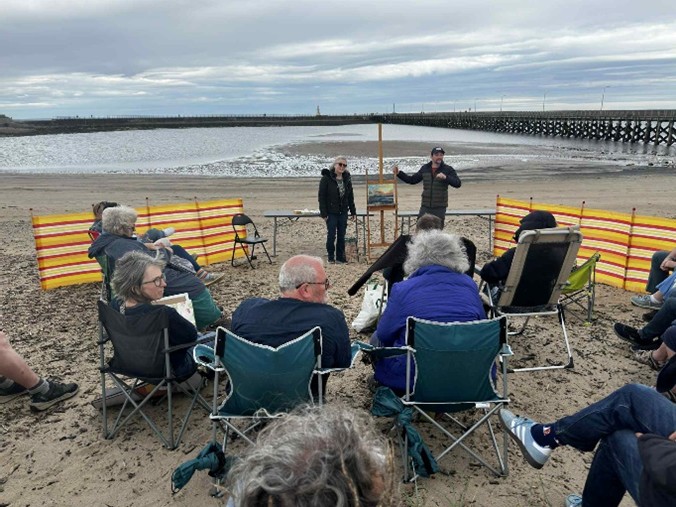
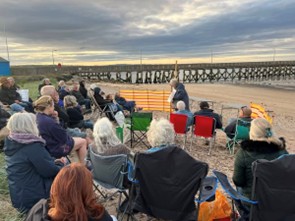
Dovecote Street Arts hosted a fabulous CRIT on the Beach evening for us on the 24th June which really helped to publicise the application to a wider audience.
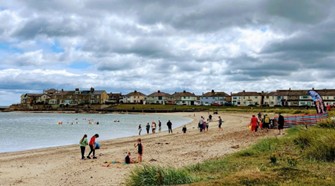
Counting bather numbers is essential to the survey and the first weekend in July saw over 100 bathers counted on both days which is fantastic. Even more swimmers were counted on a second survey day in early August.
We’ve been blown away by the support for the Little Shore bathing water application. We submitted the applciation well before the 31st October 2025 closing date so what can we expect to happen next?
From November 2025 – Februrary 2026 DEFRA will follow up with any specific questions they have about our application.
Between Februrary – March 2026 DEFRA will launch a public consultation. In 2024 this ran for two weeks from 26th Feb-10th March, and will seek views from the public about whether Little Shore should be added to the list of designated bathing waters in England.
We will be notified if our application is sucessful by 15th May 2026.
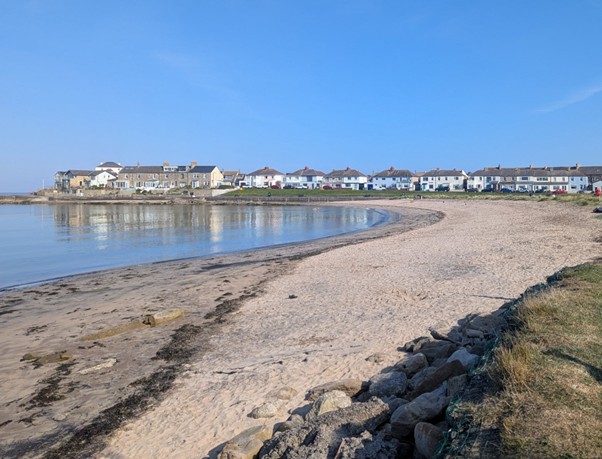
CRAG has been super busy these last months launching and supporting a bid for bathing water status for Amble’s much loved Little Shore beach. This beach at the mouth of the River Coquet has become the focus of a community-led effort to obtain the Environment Agency’s important Bathing Water Designation (BWD), bringing a boost to the family friendly shores of Amble.
A successful bathing water status designation would create a ‘blue space’ for all users of Little Shore to match those held by neighbouring Amble Links and Warkworth beaches. The application has been submitted and was supported by the Harbour Commission, Amble Town Council, Amble Rotary Club, Northumberland County Council, The Swimblers, Amble WI, Surfers Against Sewage. The application was led by the Coquet River Action Group’s (CRAG) Little Shore group.
Applying for bathing water status is a great way to ensure the beach has regular monitoring and reporting of the water quality, placing a greater obligation on the Environment Agency to take action to reduce sewage discharges and other pollution sources. It obliges the local council to provide better public information and to raise awareness of the beach’s water quality which benefits all users of the area. The status is a vital tool in protecting public health, improving water quality and ensuring everyone can enjoy the space. Applications involve a lot of community effort to demonstrate the level of usage of and community support for the beach, beginning with a public consultation and the all-important survey!
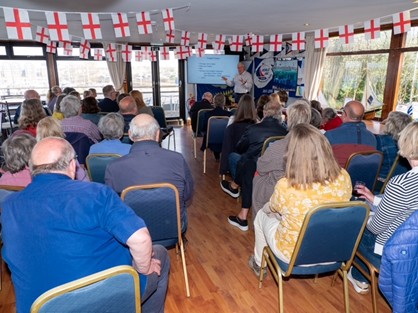
CRAG launched the public consultation on Tuesday 13th May 2025, at the packed-out Coquet Yacht Club in Amble, hosted by Amble & Warkworth Rotary clubs and supported by The Swimblers. The deadline for applications was 31st October 2025, and successful applications will be announced in 2026.
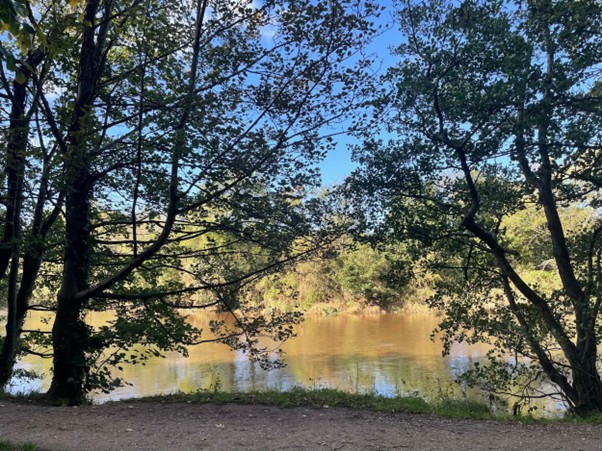
It’s fantastic to be able to contribute to this website from the point of view of someone who often finds myself observing the river, usually while waiting for my husband and the dog to return from their adventures. Usually I’m watching from a particular viewpoint: across the Coquet from the Braid, or on the path to the hermitage in Walkworth, at the confluence of sea and river at Little Shore, opposite the ‘Coquet road’ at Hauxley beach, and occasionally as far as Rothbury.
It’s never dull watching the wildlife responding to the gentle flowing and filling of the river from the estuary. One day, the fish are jumping, another day the ducks, swan and goosanders are busy regimenting their young. The herons patrol, and seem to fly off offended when their efforts are unrewarded. The cormorants pretend to be statues with their wings extended while the starlings practise mini-murmurations. The birds are in an almost constant rearrangement of themselves in which nobody ever tells them to sit still or to stop fidgeting.
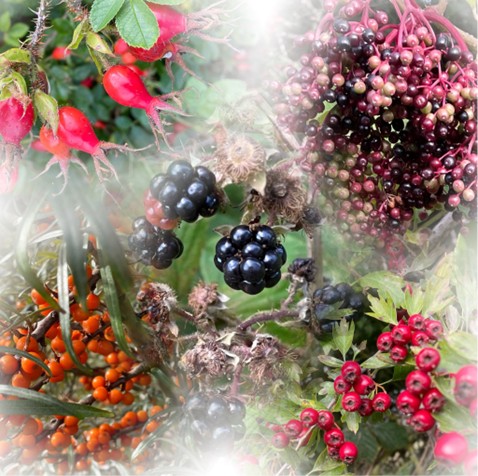
The trees and bushes and river side flora change more slowly, reflecting the seasons. Just now there’s a fine crop of fruits at the Braid. Orange sea buckthorn berries look stunning against the plant’s own silver foliage. Bell-shaped rose hips swell to bursting point. The hawthorn remembers how early and well it flowered and produces hundreds of what look like cherry red beads. Elderberries hang, apparently too heavy for their stems, like pea-sized grapes, starting green, then ripening through dusky plum to inky black. Blackberries try to last long enough to do the same, although the birds seem to take most of the fruit before they become ripe.
And, of course, there are the people, who also change with the seasons. Families are now giving over to the late holidaymakers, often with backpacks and binoculars. The dog walkers are the constants here. Some of them found quieter paths during the high season, but they are now returning to their usual haunts like migrating birds. Everyone loves to follow the river.
You’ve probably gathered already that my reflections are not based on a strong understanding of nature. I have no grounding in science, and I was brought up and worked exclusively in big cities. If I’d been born a few years earlier, I would have been a farmer’s daughter, but that’s another story. Mine are amateur appreciations, the ramblings of an enthusiastic convert. All mistakes have been carefully curated in my own head, and are definitely not to be attributed to CRAG.
People often inspire my writing, providing small vignettes for poems that are essentially moving paintings in words, or ideas for stories. As we interact with our environment, it shapes our behaviours, our thoughts, and our actions. Sometimes I get inspiration from overheard snippets of conversation, or my stories consider how humans mimic things in the natural world, or how things we do might look from the point of view of other animals.
It’s often difficult to be positive about climate change but the work of groups like CRAG show that individuals can make small differences, and work together to preserve what is most meaningful in the ‘wild’ side of our lives. The numbers of visitors to the Coquet and surrounding areas demonstrate how universal the love of natural beauty is, a common thread that unites us all. Many of us started as tourists here, then responded to the pull of this place, and now want to help preserve it. Making the transition from being a visitor to living here feels a little bit like becoming part of the wildlife or the scenery, and gives you a unique view of those who come and go here. I hope my occasional reflections can give a quirky slant on more traditional nature notes.
***
Ali Rowland won the Hexham Poetry Competition in 2023, and has been nominated for Best of the Net 2025. Her first poetry collection Rooted (Maplestreet Press, 2024) was the result of working with Dovecote Street Arts. Her latest pamphlet For the Love of Dogs with line drawings by local artists is available from the SHAK, Alexa’s Canine Trust and Northumberland Dog Rescue shops in Amble. You can follow her work at Musings of a Mad Woman on Substack.
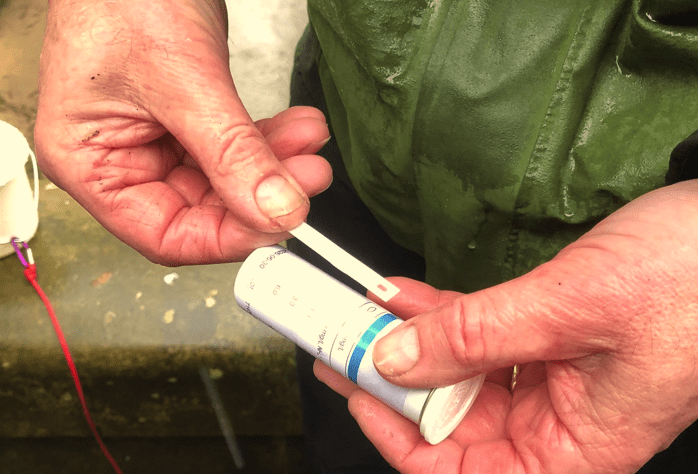
This March (2025), CRAG undertook a roadtrip through Warkworth, Felton and Rothbury. For the past year CRAG volunteers have been focusing their efforts on collecting water quality test results (indicating numerous variables, including ; pH, nitrates, ammonia, and oxygen levels), and we were finally able to feedback the results of all this hard work back to the communities.
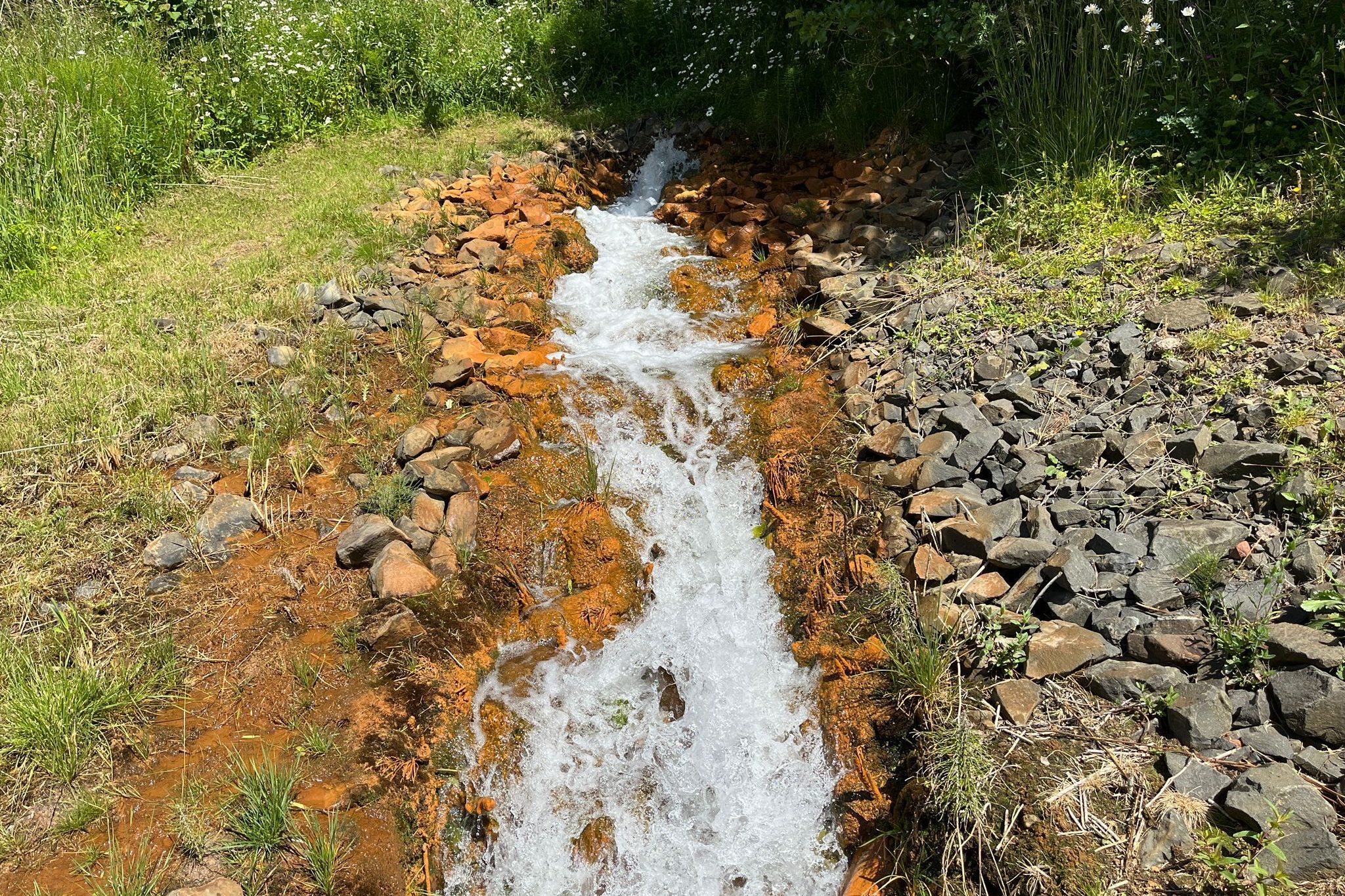
Water flowing out of the old Whittle coal mine at Hazon
At each meeting CRAG volunteers, along with other interested parties, were presented with the data they had worked so hard to gather and engaged with experts in the interpretation and discussion of the results. Check out these presentations on our results page. All that hard work collecting water quality test results- what does it mean?
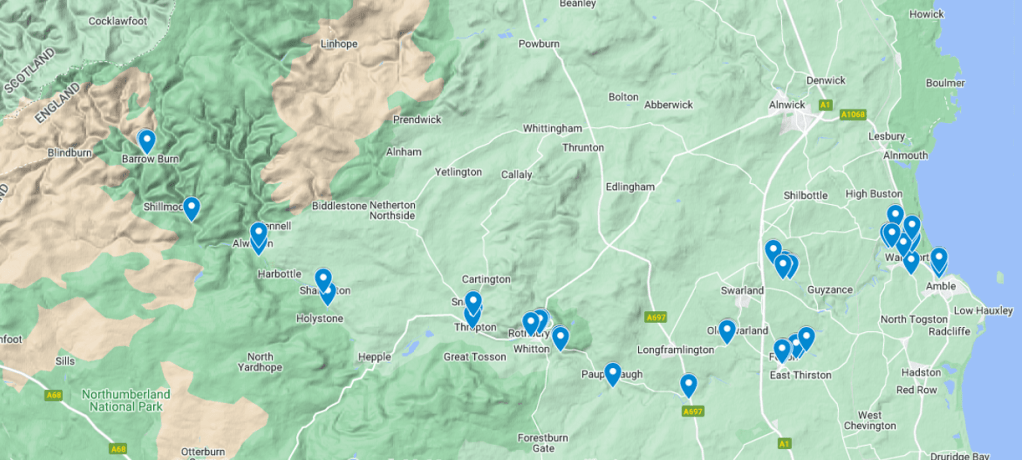
Map of our Testing Locations
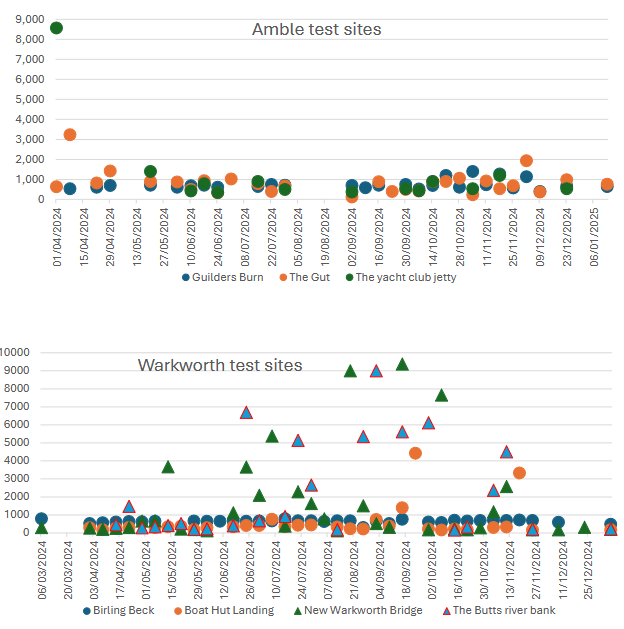
At Warkworth and Amble, there was great interest in the variability of the electroconductivity readings upstream of the half tide weir, although not in the estuary downstream of the weir. The weir is occasionally trapping salty water in the estuary around Warkworth.
Electroconductivity results in Amble and Warkworth
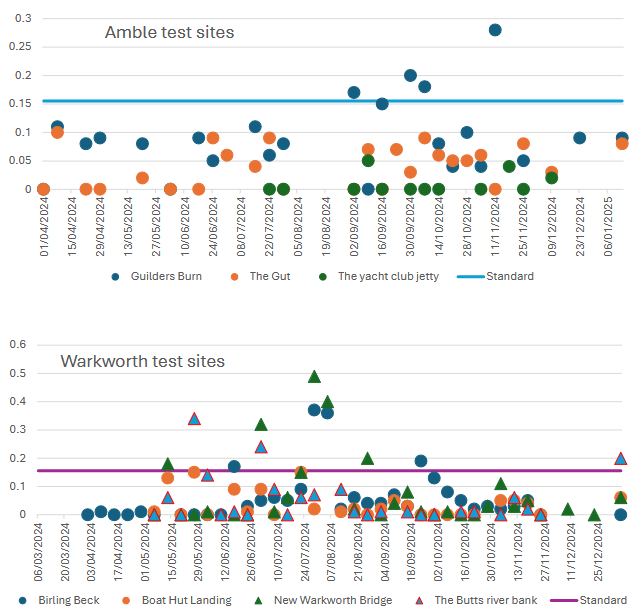
There was also concern about the high phosphate and nitrate readings in Guilders burn and Birling beck, both of which drain agricultural land.
Phosphate results in Amble and WarkworthNitrate results in Amble and Warkworth
But perhaps the most debate concerned some of the sewage spills that have occurred into the estuary and off-shore from Amble. Discussions led to speculation about what the CRAG E. coli testing in summer 2025 might show, and how this might contribute to our knowledge. Especially as the Amble Harbour Commission, the Swimblers and the CRAG Little Shores group put in an application for Designated Bathing Water Status for Little Shore in 2025.
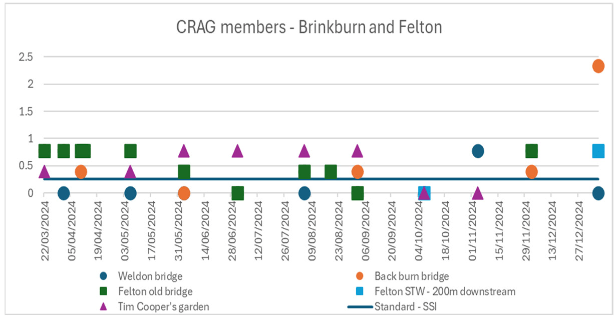
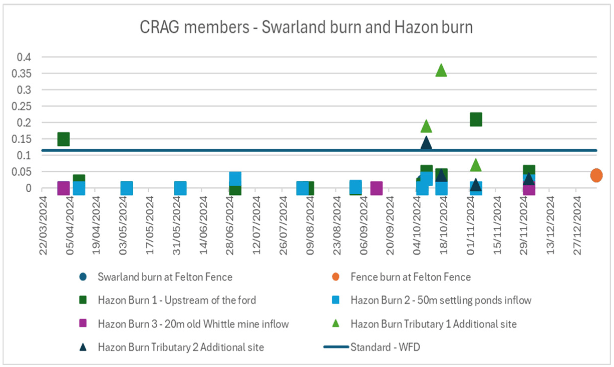
The meeting at Felton covered a large number of community groups working nearby. There were people from Guyzance to Brinkburn. The data discussed at this meeting included the main river, but also some of the main tributaries in this region including the Thirston & Longdike & Paxtondene burns, the Hazon burn and the Swarland burn.
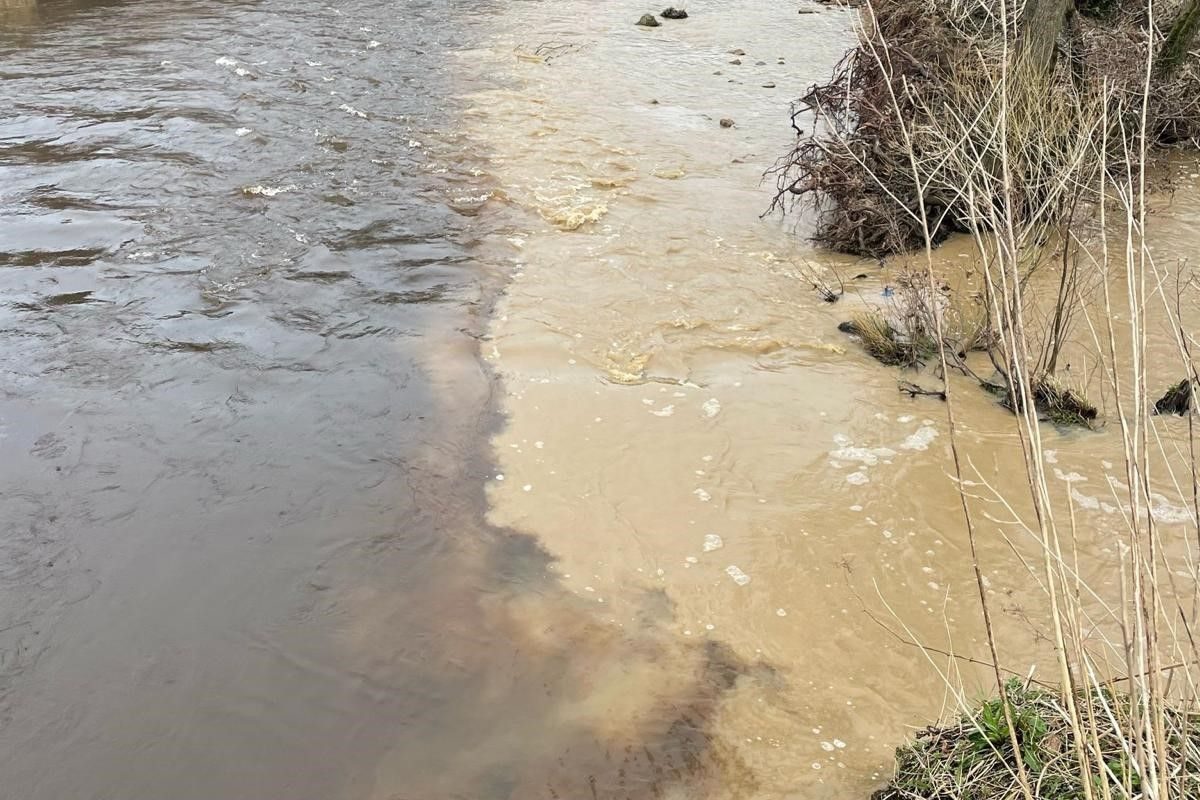
Sediment at the Thirston burn
Of most concern in this region were the high phosphate, ammonia and oxygen readings around outflows from sewage treatment works at Longhorsley, Hampeth and Felton. There was also interest in the outflow from the old Whittle coal mine into the Hazon burn– the reed beds are well managed and seem to be returning good quality water to the river. This is not the case for the water flowing from the other Whittle mine outlet on the Tyelaw burn.
Ammonia Results in Felton and Brinkburn TributariesPhosphate Results in Felton and Brinkburn Tributaries
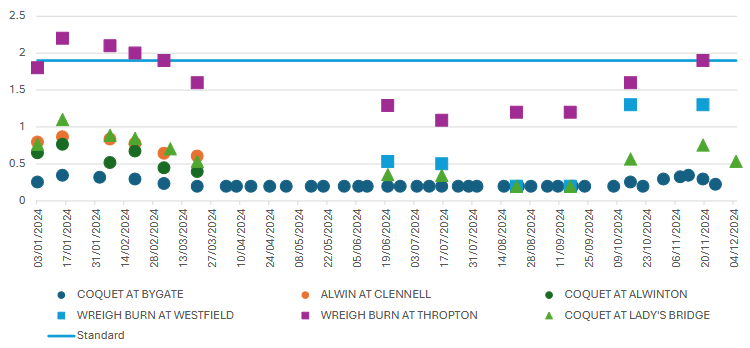
The Rothbury meeting was enhanced by the commencement of test results coming from upstream of Thropton – at Hepple, Sharperton, Alwinton and Barrow burn. There were occasional high phosphate readings in Upper Coquetdale, leading to a discussion as to whether this might be from animal sewage run-off or from poorly maintained septic tanks.
Nitrate Results at Upper Coquet
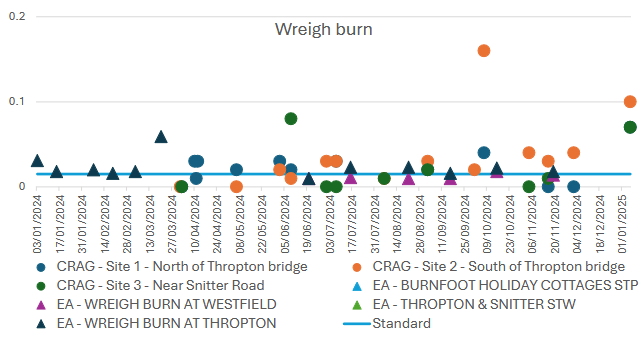
As for the Felton region, there were occasional poor results downstream of sewage treatment works. However of most concern were some of the phosphate and nitrate results on the Wreigh burn. There was a suggestion at the meeting that the poorer soils in this catchment may have led to greater leaching of agricultural fertilizers into the water.
Nitrate Results at Wreigh BurnPhosphate Results at Wreigh Burn
We learned a great deal from our investigation of the data; primarily that the river is generally in good health but that there are a few areas that we need to investigate further. We found that CRAG citizen science test results were largely in line with test results fromthe Environment Agency – giving us confidence that what we are doing will be meaningful to organisations that contribute to or manage water quality in the Coquet. We also demonstrated the benefit of communities coming together to support a cause dear to their hearts.
We know so much more about our river than we did a year ago.
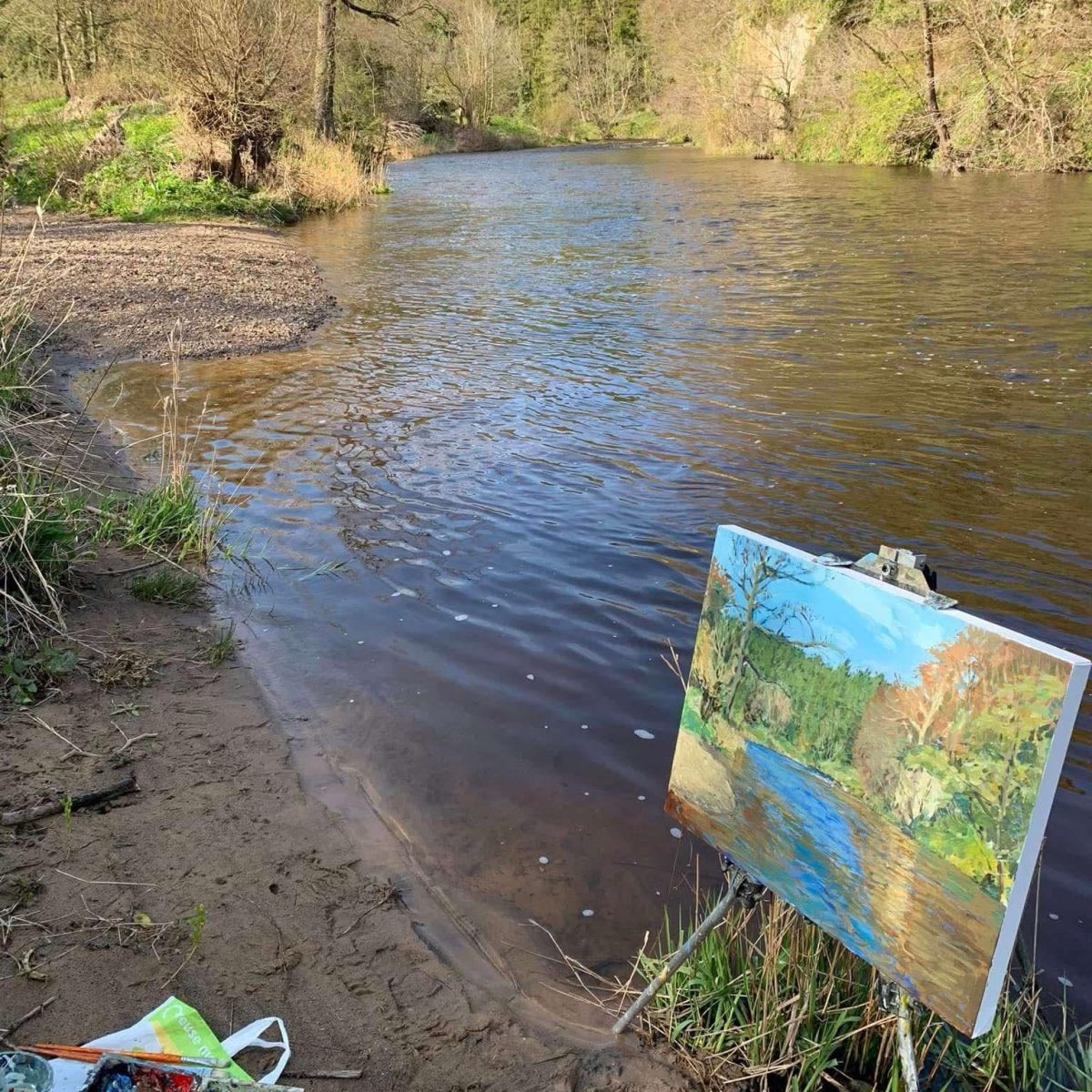
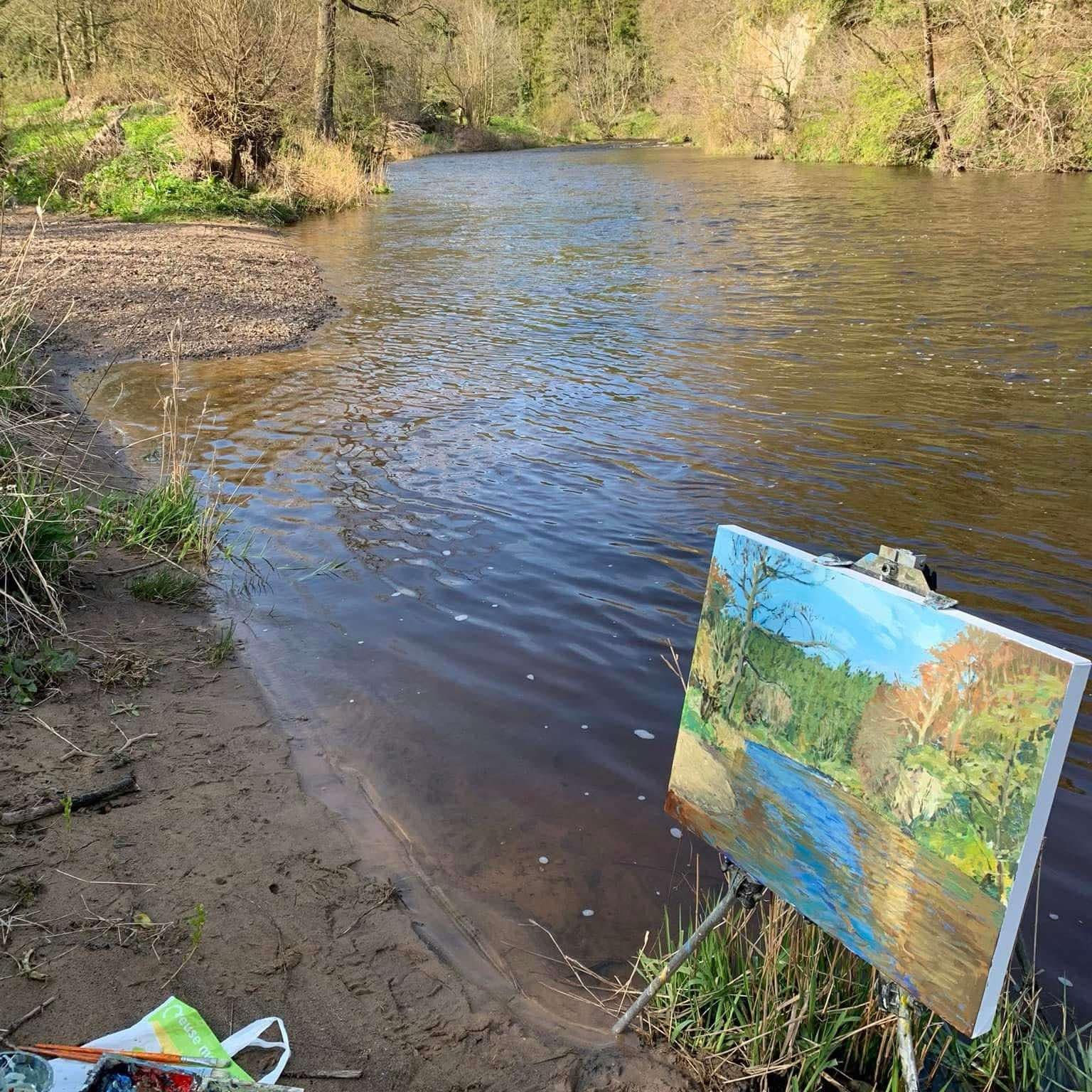
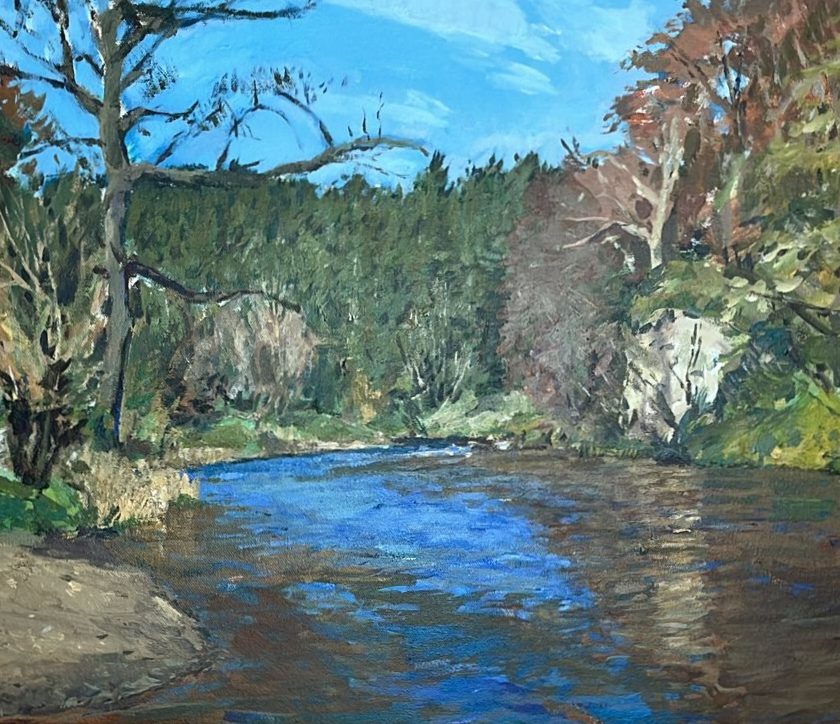
CRAG finds itself, once again, humbled by the generosity of its supporters, and wants to reach out to thank Luke McTaggart for the donation of one of his fantastic paintings of the treasured River Coquet. We hope to use this painting to raise money in future events for the continuation of our care efforts along the River.
Luke McTaggart is a local legend; a 2022 First Class graduate of fine arts from Northumbria University, he continues to excel in his career year after year. This is his second year of acceptance to the Royal Scottish Society of Painters in Watercolour exhibition, and he both organised and curated (alongside peers) the Dovecote Street Show exhibition in Amble. This beautiful creation was painted on-location, basking in new Spring sun.
When asked why he chose to donate to CRAG, he responded that he made the decision after attending the Launch event in 2025, at Swarland Village hall. “I was very impressed by the citizen science work they’ve been doing, as well as their work raising awareness of the health of our River,” he said, “I wanted to help out in some way and thought it would be a good way to help raise funds for the group.”
“Being from Amble I’ve walked the estuary my whole life. Lately I have really been drawn to a specific meander at Morwick. I love watching the wildlife and drinking in the sounds of this part of the world. I always come away restored, and I think that’s a testament to the power of nature and the importance of protecting natural assets like the River Coquet.”
He also described that he had, more recently, taken up swimming in the River, maintaining that he “hopes the work of CRAG secures the possibility of swimming in safe water for future generations”.
His perspectives on the state of the environment are bright and hopeful, as he stated; “I’m an eternal optimist and do think things can get better,” and he believes that art is a means of opening up communication with different communities regarding these difficult subjects. The support of the local art communities is an invaluable one, and for that, CRAG is grateful.
Water is extracted from the River Coquet at Warkworth and used across Northumberland and the northern suburbs of Newcastle. This is the water that comes through our taps. The water is treated by the Warkworth Water Treatment Plant to ensure it is safe for us to drink.
In November 2024, the Warkworth and Amble Rivers Group (WARivers) who are members of CRAG organised visits to the Warkworth Water Treatment Plant for CRAG volunteers.
One of the volunteers from Amble put together a very informative report of the visit. A member of the Treatment Plant agreed that the report could be placed on the CRAG website.
We’ve had some excellent feedback since the CRAG launch on the 12th September. Many people have contacted us to learn how they can get involved. We’ve also had some more information from our speakers – the presentation from the speakers, and some useful information and weblinks from Northumbria Water in response to questions that were asked on the night. This information has been included here.
Talks from the speakers
While the technology didn’t work at the CRAG launch event, most of the speakers did have some interesting slides. We include them here so that you can be reminded about what you heard.
Jamie talked about the research and data strategies for CRAG.
Research and data stretegies for CRAG
Graham Holyoak talked about the Northumberland Wildlife Trust project to reintroduce water vole to the Coquet.
Water voles of Northumberland
Steve Robson and Laura Mollon talked about what Northumbria Water do and their plans for the future.
AMP8 and WINEP
And Mark Middleton talked about National Landscape projects that will support nature recovery.
Nature Recovery Opportunities
Information from Northumbria water
Laura Mollon from Northumbria Water very kindly sent us some extra information in response to some of the questions she was asked at the CRAG Launch event.
Stormwater overflow improvement planning
Laura writes ‘All of the planned measures (by Northumbria Water) for storm overflow improvements are listed in the DWMP (Drainage and Water Management Programme). There is a postcode finder tool which may help but you should be able to click on the map at (NW DWMP (arcgis.com)) and view the PDFs.’
Parts of the Coquet that are SSSIs
Laura sent some information about those sections of the Coquet that are designated as SSSI (Site of Special Scientific Interest). She writes ‘There are water quality chemical test standards set for each individual SSSI unit for the freshwater Coquet catchment. The standards are described in the CSMG (Common Standards Monitoring Guidance for Rivers). They are tighter than WFD good status. The SSSI units are visible on the DEFRA Magic map – if you select designations, land based, statutory, SSSI units, and then zoom into the coquet area.’ (Note, the CSMG standards for SSSI units have now been incorporated into the ‘Standards that we measure against’ section of the ‘What we’re doing’ page of this website).
Information about drinking water
Laura also included some information about the testing of drinking water, specifically iron levels in drinking water. She writes ‘Broadly speaking, potable water compliance is assured at 3 points in its journey to customers. Sampling is carried out at the works (water treatment works at Warkworth), at all service reservoirs within the distribution system and then at customer taps within their homes. Sampling at customer taps is arranged around water supply zones. Water supply zones can cover houses supplied by an individual water treatment work (WTW) of houses supplied by blended water from a number of WTWs.
During the evening, I was asked about failures of Iron across 8 zones. I have since enquired on this and the data that was mentioned by a lady in the audience was information from all our water supply zones that we cover including areas in Essex and Suffolk, as well as the rest of the North East. In the case of the iron results mentioned, its unlikely to have come from the works, although we do use iron coagulants, nor will it have come from the catchments, much more likely to be localised corrosion from old unlined cast iron pipes. Most iron failures are cured by flushing the affected main, and then continued monitoring. But some are in such poor condition that we replace them alongside prioritising mains for replacement for their burst records. On top of this we liaise with local environmental health teams and the consultants responsible for public health working within the NHS on every health-related failure and then in summary with all the failures at least once a year.’
Bathing water designation
Laura sent some information about applying for bathing water status. She writes ‘Here is the website (designation-dedesignation-process-20120401.pdf (publishing.service.gov.uk) that contains the requirements for designating a bathing water, please let us know if this is something you are interested in taking forward so we can align any investment needs, and work with you.’
Forever chemicals
Finally, Laura sent some information about ‘forever chemicals’ and heavy metals. She writes ‘:
polybrominated-diphenyl-ethers-pressure-rbmp-2021.pdf (environment-agency.gov.uk) – Information on PBDE which fails WFD chemical status for all waterbodies in England. The report covers the sources and the impact. From the report you can see that a limited amount of testing was done to designate all river waterbodies. Testing for this substance is done mainly by analysing fish tissue rather than water quality testing. There is an improvement trend in the levels found due to the ban of general use and restriction of specialised uses, this will continue over time.
mercury-pressure-rbmp-2021.pdf (environment-agency.gov.uk) – Similar to PBDE, mercury is the other substance that fails every waterbody in England. The main sources of mercury are mainly due to air emissions, but this is improving over time.
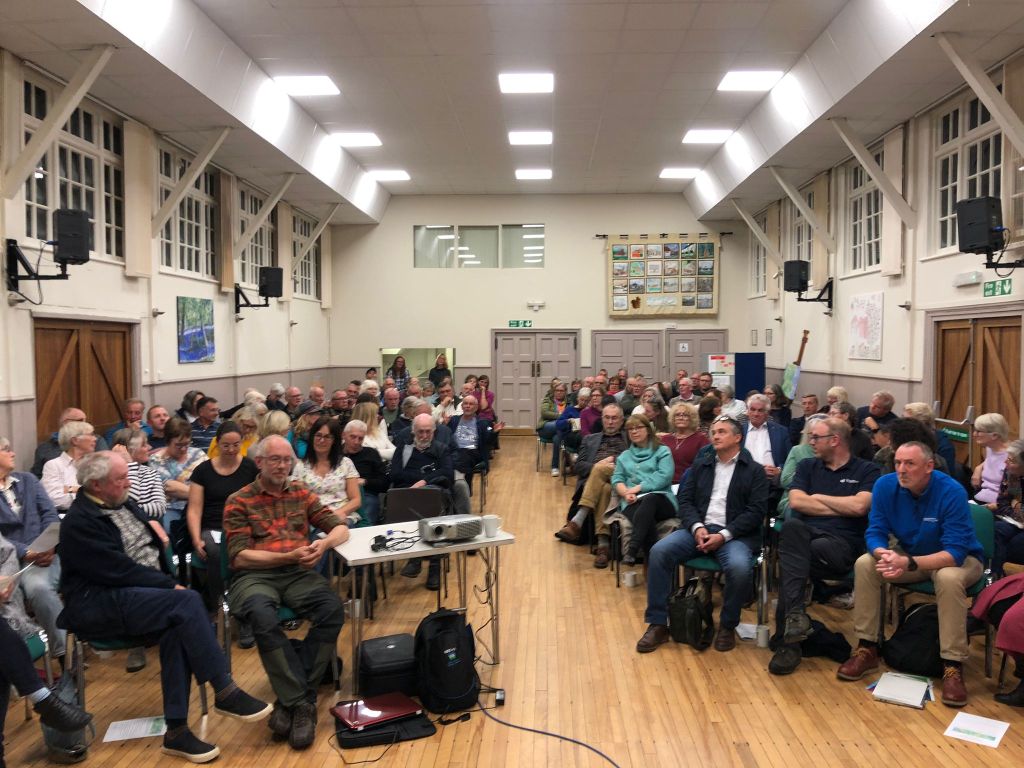
More than a hundred people attended the launch of the Coquet River Action Group (CRAG) at Swarland Village Hall this week
A large turnout reinforced what an important issue this is to many people and the wide range of interests in the river and its biodiversity. CRAG is bringing together many groups including parish councils, Women’s Institutes and environmental action groups as well as the Northumberland Rivers Trust. Volunteers from all these groups are carrying out citizen science water quality testing along the River Coquet.
Chair of CRAG, Jane Davis, explained that the aim is to collect scientifically relevant data that can be used to collaborate with other organisations to form a ‘catchment community’ working to improve the river and its habitats.
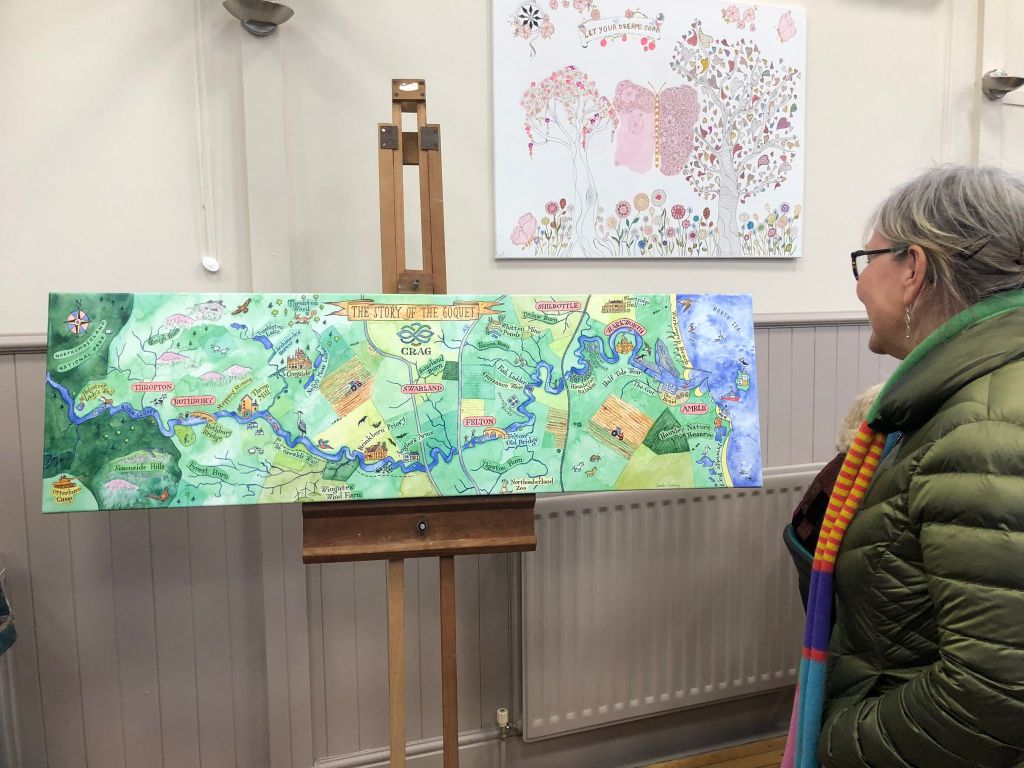
On display was the fabulous ‘Story of the Coquet’ picture created for CRAG by local Felton artist Sarah Farooqi and funded by a very generous donor which attracted a lot of attention.
Steve Lowe, from the Northumberland Rivers Trust, told the audience that although the Coquet is a SSSI there are still many issues including invasive species, mine water legacy and farming-related run-off.
Graham Holyoak from Northumberland Wildlife Trust talked about plans for the Druridge Bay area, focussing on a number of key species including water voles. Steve Robson and Laura Molon from Northumbrian Water provided an overview of the multi-million-pound investment plans to reduce sewage overflows and improve sewage treatment works. Lastly, Mark Middleton from National Landscapes talked about a variety of projects taking place around the Amble and Warkworth.
An enthusiastic question and answer session included discussion about extending the project into the upper Coquet, how to obtain Designated Bathing Water status, issues related to mine water pollution and ‘forever chemicals’, the types of monitoring carried out by Northumbrian Water and how to get young people involved in the project.
Finally, Jane invited anyone who is interested in getting involved to email CRAG at coquetriveractiongroup.outlook.com or to visit the website:https://coquetriveractiongroup.org for more information.






 CRAG
CRAG 